
The realization by administrators, teachers and parents that online courses can fill gaps in course offerings as well as complement traditional classroom instruction with engaging, interactive materials has generated many questions about implementing online learning programs:
- What does an online course look like?
- How do students interact with their teacher?
- What qualifications and training are required of teachers?
- Does online learning really work?
- What state or school district policies are needed to implement online learning?
Highlights include:
- iNACOL’s official online learning definitions
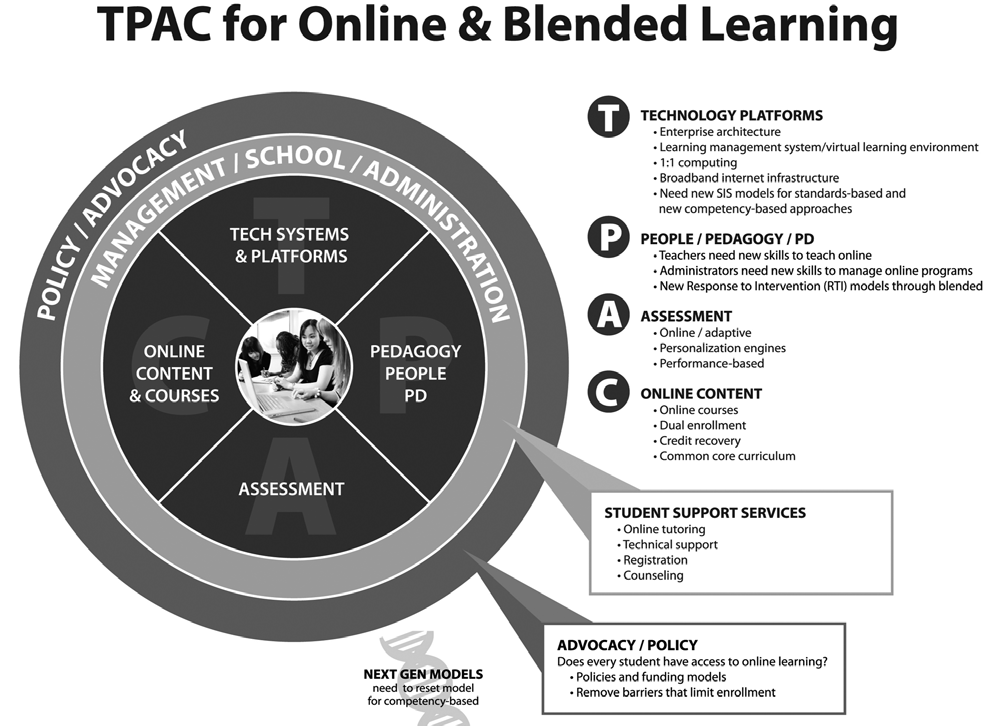
- A framework for online and blended learning adapted from the TPAC model to describe the key elements as an approach to systemic educational transformation (see chart below).
- Asynchronous communication: Communication that is separated by time. Examples are email, online discussion forums, message boards, blogs, podcasts, etc.
- Blended learning (also hybrid learning): Learning that is facilitated by the effective combination of different modes of delivery, models of teaching and styles of learning, and is based on transparent communication amongst all parties involved with a course.
- Credit recovery: Refers to a student passing, and receiving credit for, a course that he/she previously attempted but did not succeed in earning academic credit towards graduation.
- Cyberschool (also online school and virtual school): A formally constituted organization (public, private, state, charter, etc.) that offers full-time education delivered primarily over the Internet.
- Learning Management System (LMS): The technology platform through which online courses are offered. A LMS generally includes software for creating and editing course content, communication tools, assessment tools, and other features for managing the course.
- Online course: Any course offered over the Internet.
- Online learning (also cyber learning, elearning, and virtual learning): Education in which instruction and content are delivered primarily over the Internet; online learning is a form of distance learning. The term does not include printed-based correspondence education, broadcast television or radio, videocassettes, and stand-alone educational software programs that do not have a significant Internet-based instructional component.
- Online teacher: The person who is responsible for instruction in an online course.
- State virtual school: An entity created and supported by a state to provide online academic courses to elementary, middle, and high school students using qualified online teachers.
- Synchronous communication: Communication in which the participants interact in the same time space. Examples are telephone calls, videoconferencing, chat, and face-to-face communication.
Educators interested in finding out more about online learning can download a copy for free here.
-----------------------------------
Editor’s note: This post contains numerous excerpts from the National Primer on K-12 online learning's Preface from Susan D. Patrick, President and CEO, International Association for K-12 Online Learning (iNACOL).
You have read this article blended learning /
hybrid learning /
iNacol /
online learning /
vss2010
with the title
. You can bookmark this page URL http://machining33.blogspot.com/2010/11/the-introductory-guide-to-online.html. Thanks!


